Static data publishing
Public Data Websites
A set of static websites built from public datasets to make healthcare, benefits, and pricing information easier to discover and understand.
At a glance
Project Origins
These sites came from a shared idea: a lot of useful public data exists, but it is often trapped in bulk downloads, spreadsheets, PDFs, agency pages, or machine-readable files that are hard for normal people to search and understand.
The project was to turn different public datasets into fast static websites: search-friendly enough for people to find through ordinary web searches, structured enough for search engines to understand, and practical enough to make the data more available to the American people.
Technical Highlights
- Uses static generation so large public datasets can be published without a production application server.
- Normalizes raw public data into SQLite-backed build pipelines, then writes crawlable HTML pages and sitemaps.
- Applies the same operational pattern across multiple domains while adapting each site to its source data and audience.
- Uses canonical URLs, metadata, breadcrumbs, JSON-LD, and focused page titles to make generated pages understandable to search engines and readers.
- Runs deployment through S3, CloudFront, Route 53, and project-specific Makefile operations.
NPI Providers
NPI Providers turns National Provider Identifier records into static provider pages and browse paths. It starts with NPPES provider data, taxonomy lookups, endpoint records, and Medicare activity signals, then publishes profile pages that are easier to read than the raw registry rows.
A representative page is the Carie E Bradt NPI profile. It is useful because it combines the public NPI record with practice location, specialty, endpoint, and Medicare activity context on a single page. That gives a reader one clear page for a specific provider instead of making them piece together data from multiple federal files.
MedCostCompare
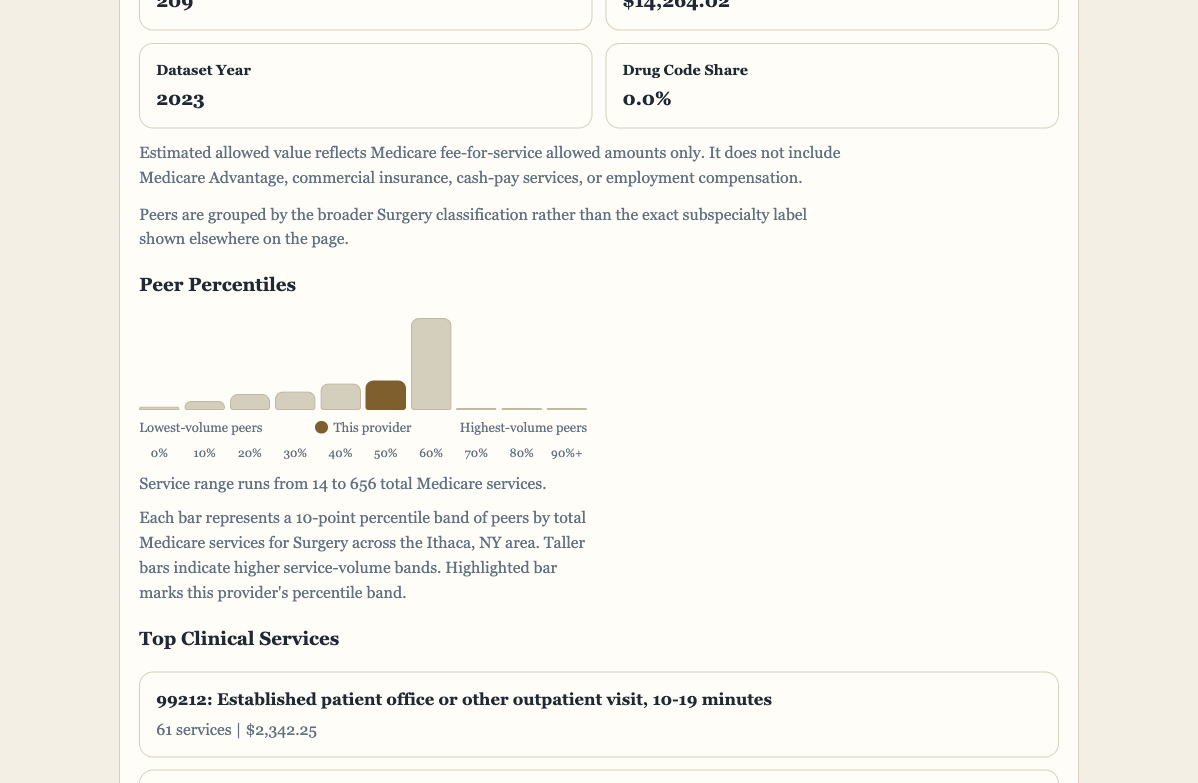
MedCostCompare uses public Medicare provider-and-service data to compare procedure prices by metro area. The site focuses on procedures where patients may reasonably want to compare local options, such as colonoscopy, cataract surgery, echocardiogram, retinal imaging, and screening mammograms.
A representative page is the Rochester, NY colonoscopy comparison. It is useful because it turns a dense CMS provider-service report into a local price range, provider list, billing-code context, and plain-language caveats about what the numbers do and do not include.
EBTCheckup
EBTCheckup publishes state-by-state SNAP and EBT information from public benefit sources. It brings together deposit schedule rules, deposit timing evidence, SNAP purchase rules, Restaurant Meals Program context, official sources, and reviewed benefit news.
A representative page is the California EBT state page. It is useful because it gives a household one place to estimate a deposit date, understand when benefits may become available, review current CalFresh news, and check state-specific food-rule exceptions with source links.
Hospital Cost Finder
Hospital Cost Finder explores hospital price-transparency data and CMS hospital reference data. The site turns machine-readable hospital pricing files into local pages for scheduled care, with service pages, hospital pages, and pairwise comparison pages for specific procedures.
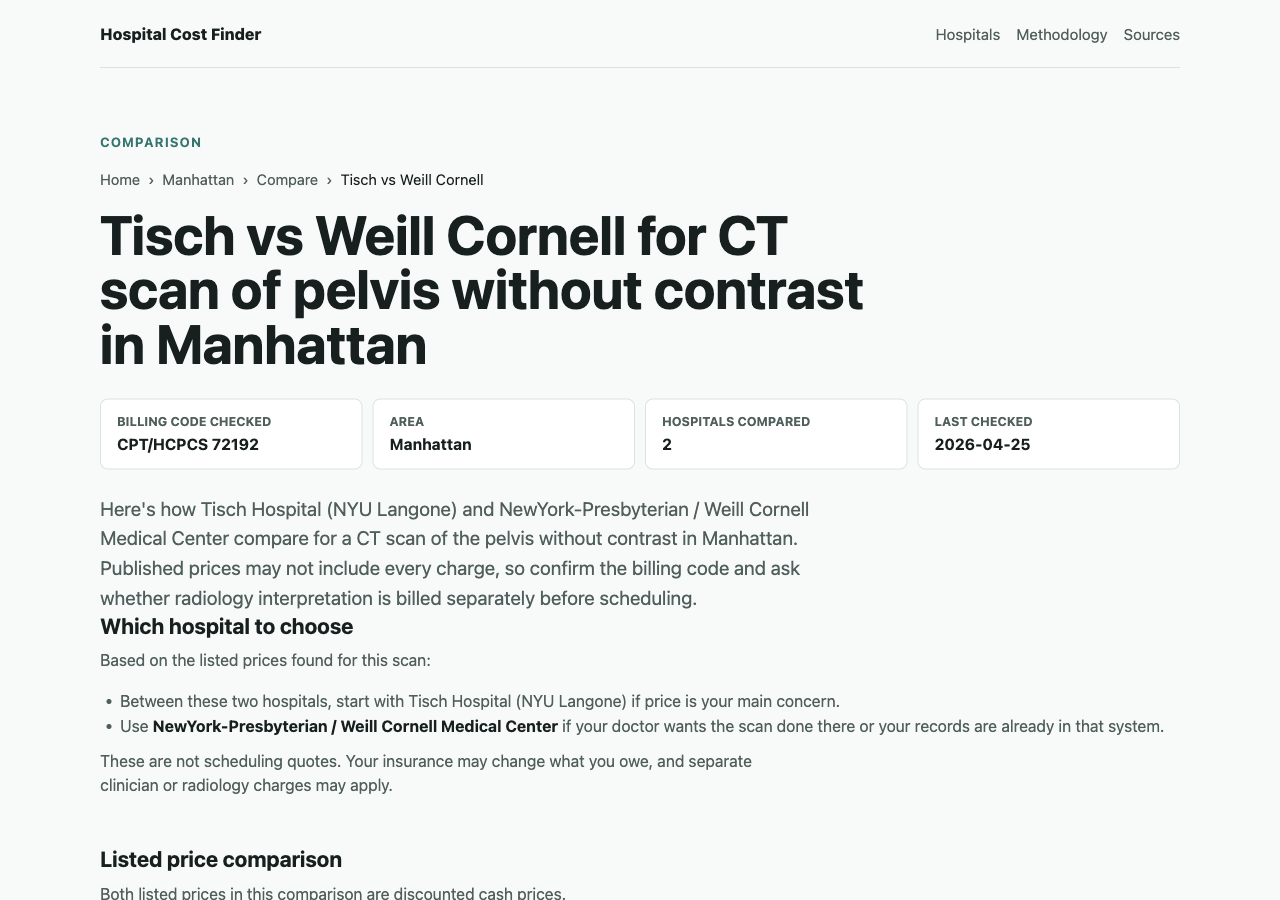
A representative page is the Manhattan comparison between Tisch Hospital and NewYork-Presbyterian / Weill Cornell for a CT scan of the pelvis without contrast. It is useful because it presents a direct comparison for a real scheduled service, shows the listed cash-price gap, and gives patients concrete questions to ask before scheduling.
Project Images